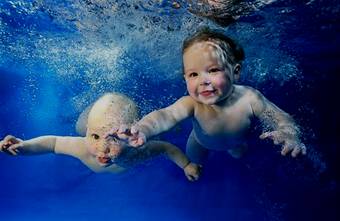
Showing posts with label baby going under the water. Show all posts

May 22, 2026

Is your child addicted to using goggles?

Children may develop a dependency on goggles because they are used to closing their eyes the tub or shower.  If one day they go to a pool and forget their goggles, they won't go in the pool without them.  Or, they might jump in the pool and their goggles fall off, so they panic and may not be able to swim to safety.  


When a baby starts swimming at under 2 years old, they don't need goggles to swim but as they get older they become more sensitive.
If we really want our children to be water safe we need to have them practice swimming with their eyes open without goggles.  The child needs to know that what they see will be blurry but they CAN SEE under the water.  Play the game that i call The Dolphin with a parent.  Here is D with his dad.


Or you can put a toy or a prize, on the step or in your hand for the child to get. Do it several times and make it a game!  It doesn't take a lot of time and it will help your child be more comfortable and secure in the water.  Practice several times a year especially if you see your child is depending on goggles to go in the water all the time.

May 2, 2026

The Baby Diving Reflex and the Swallowing Reflex


Humans have a swallowing reflex that is triggered automatically when liquid passes the throat. The epiglottis closes over the airways, so that no liquid enters the lungs. In addition, babies are born 
with a diving reflex that makes it possible for a baby to be submerged safely under the water. The epiglottis closes automatically as soon as the water touches the baby's face. Once above the water again, the breathing and swallowing actions return automatically, sometimes with a small cough. Some experts that say that the dive reflex disappears after 6 months, but practice shows that the dive reflex continues much longer. When baby is in the water, he is stimulated automatically to move, and thus, at a very early age, the baby begins to actively move the arms and legs as if swimming. The diving also helps to strengthen the baby's lungs and other organs. In addition,  the baby "enjoys" the feeling of  weightlessness in the water.  It mu"remind him" of  when he was in the womb. Parents say that their baby sleeps better after swimming and, some believe that babies who participate in baby swimming get sick less often than non-swimming babies.

Parents can learn how to submerge their young baby under water with confidence.  There are several techniques and signals that parents can use.


The first time you submerge your baby is the hardest. The baby may act surprised and even cry out. But 
if you stay calm and happy and react positively, the next time you dunk him, your baby will love it! 
There is a new baby program from Denmark that has some great pictures and videos of 2 month old 
babies diving. Look for them at Active Baby Swimming on the web and on youtube. I also have videos and pictures on my swimbea website and YouTube: Learn to Swim with Miss Bea

Also, write to me with your questions or concerns.

In addition to showing you how to put your baby under water, the Learn to Swim with Miss Bea dvd also demonstrates tricks for teaching swimming to kids of all ages that I have developed through experience, from reading books, and from strategies that other parents and swimming teachers have shared with me through the forty years that I have been teaching swimming.  Try this technique as shown in this video:

How a baby goes under water, holding his breath 


You, as the parent are the best person to practice with your baby and act happy that he won't swallow water when you put him under the water.  The above video, from the Learn to Swim with Miss Bea dvd,  demonstrates the reflex of taking a breath when air goes on a baby's face.  If your baby makes the funny face when you blow in his face, then you can use this reflex.   Try it! Count to Three, blow in his face, watch him take a breath, then gently put him under water for a second.  James' mom taught him the signal and then used this technique. then praised him and talk happy...  It is imperative to always be very clear with your signals.  The child is under your power and it is up to you to make him feel secure.  Be clear and consistent with the signals.  There are signals for everything:  the "one, two, three", the blowing in the face, and other signals for going under the water.  Then you will play at back floating, kicking, playing "peek a boo" with you, turning to the wall, etc.  When you watch the dvd, you gain confidence and can do it with your own baby!

October 25, 2012

how to teach your baby to swim (under 7 months)


Here are the proven instructions to teach babies to go under water if under 7 months using the air in the face reflex:
Blow like a gentle gust of wind onto the baby’s face.  You can see your baby take in a gulp of air and/or make a funny face – do this several times before you go in the pool to see if your baby still has this reflex. (This reflex is usually lost between 4 and 9 months)

Follow these steps in the pool:
  • After the baby is comfortable and playful in the water, hold the baby under the arms facing you, and make eye contact with your baby. 
  • Count to three to set the signal,
  • blow quickly on your baby’s face
  • watch your baby make the funny face
  • smoothly and gently lower the baby’s head completely under the water for one second
  • When you raise your baby, wipe your baby’s nose so that not even a tiny water bubble will go into the nose. 
  • Give your baby a hug to your chest so that the baby will blow out and not swallow any air.  Skipping this step may cause the baby to develop a hard tummy.  This may become a big burp, and may even lead to throwing up.  
  • Immediately distract your baby with a toy.
  • Do this about 5-10 times a session if the baby doesn’t show any discomfort.
  • Extend the time under the water to up to 5 seconds pulling your baby toward you for a short glide as you step back.
  • Place your hand gently behind your baby’s head gliding your baby to another person.
  • Scatter underwater practice with practice on the other skills as instructed on the dvd, and playing with your baby.
  • Enjoy your time together!

March 13, 2012

Why do young children drown in shallow water?


How can a 2 year old who loves the water drown in shallow water?  

Have you heard of a baby who drowned in the bathtub?  How can that happen? 
The parent only left the child alone for  "a minute"! 

onto his belly and he doesn't know how to push himself up.  

We have to teach our baby to push up.  It is not an easy task for a baby or a toddler, even when they can do it on land!  

I believe that there is a valuable skill that very few parents and swim instructors address.  Even if a child can hold his breath and even swim a little, they can become a drowning statistic.  

Can your child go to a stand up position in shallow water from a prone swimming position?  

Let’s say your child is playing on the steps of the pool or in a shallow “baby pool”.  I have taught children who can swim from me to the side of the pool, but when they slipped on the steps they could not get up; did not think to reach for the step and push their faces up.  Parents and swim instructors, practice this with your child!  Teach how to stand up in shallow water.  It is a necessary survival skill.